This post, or most of it, was published password-protected once
because… well, I explain that below. (To the one person who actually
bothered asking me for the password, just so you know, I did add and
rewrite parts. More than a few.) I forgot how distinctly powerful a
disincentive a large 2300-word block of text is to the average person,
especially when the subject of half of those 2300 words is teenage angst
(I’ve already linked to xkcd 1370
in enough places so I’m not even going to embed it here) interweaved
with an insufferable amount of rationalist jargon. This will probably
filter my readership more than sufficiently already.
I have still decided to protect one detail of the thought process,
though. But even after that, I guess I do care more about how many
people read this than I do for most of my other posts, so here’s a
primitive attempt to gauge interest; if you choose anything beyond the
first choice, I would also appreciate if you leave a comment, even if
you don’t think you have anything to add:
edit: This poll has been removed, it wasn’t very interesting anyway.
I haven’t posted for a long period again, but I don’t feel too bad
about it.
Well, until I look carefully at my blog draft folder and remember
that I have 90%-finished drafts about the two debate competitions I went
to (November 2013 and March 2014), and winning the previous Mystery Hunt
(January 2014), and my summer trip to Penghu (July 2013). Which will
probably never get posted out of awkwardness.
Oops.
But I’ve been busy, completely righteously busy, with college apps to
write and algorithm classes to teach and speeches to write and a math
club to sort-of lead and all the typical homework besides.
And then (for those of you who don’t have me as a friend on Facebook)
I got accepted to MIT and Caltech early.
And for a few days after that, I checked Facebook about sixteen times
a day for the Class of 2019 group discussion, except for one day when I
really needed not to, thanks to the power of committing to my HabitRPG
party to do something. I am increasingly learning that procrastination
is something that has to be actively and strategically fought. But
that’s not what this post is about.
Unfortunately I don’t have time for anything more complex, so here’s
a low-effort illogical puzzle for the occasion. (It has been
testsolved, at least. Thanks, Yoshiap.) It also features a brand new
category, so as not to distract the people on LMI.
If you don’t already know what occasion it is, it’s easy to find out
by looking through my archives or possibly anywhere else I’ve left a
trail online. Or you could solve the puzzle! (Or you could
scroll down to read the
solution!) If this puzzle had an answer, it would be a nine-letter
word, although like most of mathematics, it’s less about the answer than
about the path you take to get there…
2017 edit: A warning that this has somewhat linkrotted and is harder to
solve, but theoretically still possible.
The “Extreme Value Theorem”, according to my old calculus textbook
(Larson, Hostetler, Edwards, 8th ed.), is “A continuous function defined
on a closed interval attains a minimum and a maximum on the interval.”
The calculus textbook continues,
Although [it] is intuitively plausible, a proof of this theorem is
not within the scope of this text.
Of course Rudin proves this, but coming from an unrigorous calculus
background, the required deductions span three chapters and are very
hard to motivate. That’s probably because it proves things for extremely
general objects.
In particular, I have no idea why the definition of “compact” is what
it is: “a set for which every open cover has a finite subcovering”.
Therefore, here’s a less general but more motivated proof, from the
grounds-up.
Definitions
Real numbers are hard to define. We only need to
know that we can add, subtract, multiply, divide, and compare them,
i.e. they’re an ordered field, and that they have the
least-upper-bound property. That is, if we have a set
of real numbers that are bounded above, then the set has a least
upper bound, a bound that “perfectly fits” the set. Precisely, the
bound must be such that every element of the set is less than or equal
to it, and no smaller value satisfies the same property.
Continuing the porting of stuff from betaveros.stash, and adding more
stuff.
Mnemonic
Here’s my mnemonic table for digits, inspired by an old Martin
Gardner column. I wrote from memory the first 132 digits of 2012!
correctly at IMO 2012 with this table. I had remembered more, but
unfortunately, if I recall correctly, I confused myself over whether I
had encoded a 5 or a 2 by the S of “nose”, because this is supposed to
be more of a phonetic code than a spelling one — otherwise double
letters would be confusing and lots of randomly appearing digraphs would
be wasted, because English is weird.
Miscellaneous observations that didn’t make it into a compelling
narrative, sometimes because I have forgotten exactly when they
happened, sometimes because I only remembered when they happened after
blogging about it, sometimes because it just seemed too tangential,
sometimes just because of the circumference of the mooooooooooooooooon!
(That made no sense and I’m not going to remember what I’m alluding to
in a few months.)
During the first day a guy came into the secret computer room that the
Taiwan team had concealed themselves in, saw us watching anime (SAO 2
among others), and innocently asked, "Are you the Japanese team?"
The organizers had provided a free whack-a-mole machine, two basketball
machines, a Kinect, and a table soccer table in the basement outside the
dining hall. I don’t know what it is with science olympiads and table
soccer; it’s been provided at all three Olympiads I’ve gone to. Can this
be just a fluke?
Paul spent most mornings and evenings playing
Kingdom Rush in our room.
Kingdom Rush is a great game, but the reason I put it here is that I was
mildly amused to see a Kingdom Rush screenshot in
Evan’s
IMO 2014 report when it came out. Things that transcend boundaries…
Somewhere among the many occasions when I abruptly switched to English
to greet my classmates, our team developed the "Hey, Brian!" meme, which
then got two letters transposed. Just for your information.
I spotted T-shirts from IOI 2011, IOI 2012, IOI 2013, IMO 2012, Google
Code Jam, TopCoder, Codeforces, Dropbox, and Quora.
There really does appear to be a critical mass of confused people dining
in one place above which clapping for no reason is contagious. I
observed this during IMO
2012 too. The new thing I learned was that the same trick also works
with singing “Happy Birthday” to some degree.
During one of the bus rides, I was randomly pulled into a conversation
about Phineas & Ferb. I impressed some contestant (I don’t remember
which country he came from, unfortunately; it might have
started with a T?) by mentioning the English name of the evil genius,
Doofenshmirtz. (For a few seconds I wondered if I had met
a
certain IMO legend again.) The guy congratulated me, then remarked
that my eye cover made me look like a character from Happy Tree Friends.
"It’s not good news to be a character from Happy Tree Friends.
Especially since we’re on a bus. Do you know the episode on a bus?" I
didn’t know the episode on a bus, and I was pretty sure I preferred not
to know.
I still remember xyz111, the full scorer from China, for writing the
Codeforces round (#254) that
totally
pwned me (my first rating decrease!) and then issuing an editorial
in response to an unexpected solution saying,
This is my mistake, and I feel sorry for not noticing that, I’m too
naive, and not good at solving problems. Please forgive me.
No, I didn’t forget. Not for one minute. I was doing homework. I am
very happy because that means I was actually carrying out my priorities
as I envisioned them. I’ve probably edited this post too many times,
though. Meh. But it’s the first weekend after finishing summer homework,
so here we go again!
Fun fact: This is by far my favorite post title in the entire series.
Possibly in the entire history of this blog.
In the morning of the last day of official IOI activities, there were
a bunch of cultural activities, e.g. writing Chinese characters
calligraphically, doing tricks with the diabolo, or picking up beans
with chopsticks, and noncultural activities, e.g. getting somebody to
pour water into a cup on your head while he or she was blindfolded. Due
to the last activity I got wet, but my shirt dried really quickly. And
alas, even though I had taken calligraphy summer classes a long time
ago, my calligraphy was awful — robotic, lifeless strokes without the
right aesthetic proportions to make up for it. Blargh.
Anyway, lunch followed, and then it was time for the closing
ceremony, in the same building as the other ceremonies and contests. Our
team caught the ending song of in a Chinese musical being rehearsed as
we walked into the auditorium. While we waited for everybody, we milled
about waving flags that our various teachers had brought, including not
only Taiwan’s flag but also flags of my school, thoughtfully brought by
teachers who had volunteered. A little later our leader told us that all
the leaders had discussed the matter during a meeting and decided that
we shouldn’t bring any flags to the stage while receiving our medals, so
we were going to have to make do with being patriotic and
school-respecting off stage.
There were a few performances, including two aboriginal music
performances and the musical we had seen rehearsed ealier, which was a
fun rock musical rendition of some Chinese tale that seemed to have been
sharply abridged, giving it the plot depth of a Wikipedia stub-article
synopsis — a conflict, boy-meets-girl-and-falls-in-love, and a lamenting
Aesop song conclusion with thrillingly vague general applicability. But
the singing and counterpointing and atmosphere were good. I guess it was
proportional to the relative importance of the performance to the
closing ceremony. The program interleaved them with the long-awaited
medal presentations: one round of bronze medalists, one round of silver,
one round of gold.
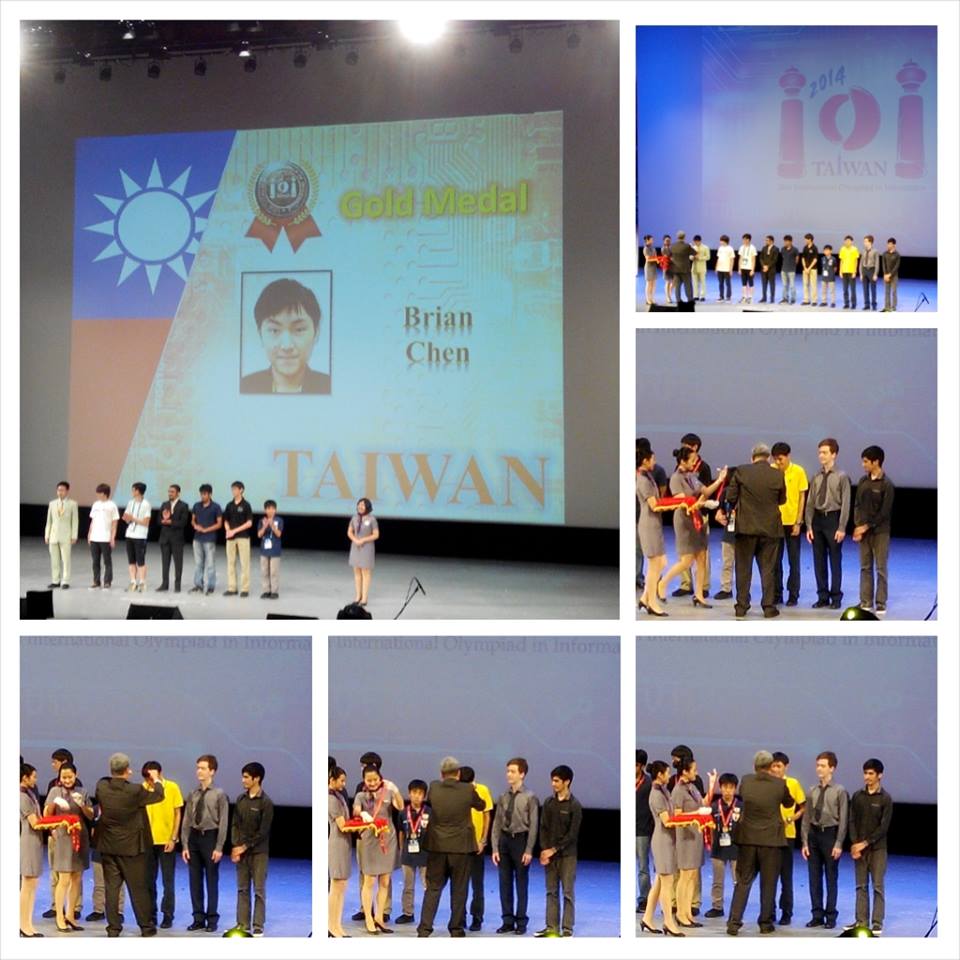
Dum-dum-dum-dum, medals! The home team advantage was really obvious
here; the cheering and the medal-presenter handshakes were both
significantly more forceful for Taiwan’s medalists.
I think our leader made this. Thanks.
Naturally, after the normal medals had been exhausted, the three full
scorers received bags with prizes that may forever remain unknown to my
sorry self, as well as a standing ovation from everybody in the
auditorium. The orchestra had been going through ABBA songs during the
ceremony, and very considerately played “The Winner Takes It All” for
this part. It was impossible not to mentally fill in the lyrics.
The winner takes it all The loser has to fall It’s simple and
it’s plain Why should I complaiiiiiiiin?
Speeches followed. Most were just average forgettable speeches, but
Forster gave another speech that was somehow even better than the one he
gave at the opening ceremony, with nonstop golden quotables such as:
Shamelessly getting unfinished business out of the way. Yup, that’s
me.
Excursion Day 1. We traveled down to Yilan on a bus. I played
guess-it with Paul.
I was quite surprised at myself for remembering this game, but I think
it’s simple and little-known enough to be worth mentioning. Guess-it is
a remarkably pure game of luck and bluffing from one of Martin Gardner’s
columns, played with a small odd number of cards, e.g. the 13 cards of
one poker suit. The cards are dealt evenly to players (who can look at
them) with one card left over, which is kept face down; players take
turns choosing one of two actions:
Name a card and ask the other player if he or she has it. These
questions must be answered honestly.
Guess the left-over card. The guesser wins if correct; the other player
wins if not.
Guess-it is not trivial because sometimes you should ask the other
player if he or she has a card that you already see in your hand;
otherwise whenever you answered “no” to a query you’d immediately guess
that the asked card is the hidden one. It is actually a solved game in
the sense that the probabilities of the Nash equilibrium strategy for
when to guess and when to bluff have been worked out already, but
they’re not simple probabilities by any means and humans are terrible
randomizers anyway. A few rounds of it sure beats rock-paper-scissors. I
was very amused to lose almost all our games with 11 cards but win
almost all of our games with 13.
Okay, no more gratuitous narrative excursions into game-theory. The
first stop, National Center for Traditional Arts, was a very laid-back
culture place with old-fashioned retro shops and streets.
We watched a 3D glove puppetry (布袋戲) video, in the same session as
a lot of the leaders.
I started trying to sleep at 9 the night before the contest, tossed
and turned in bed until 10, then fell asleep and got up at 3:35 in the
morning. Blah. At that point, I went to the bathroom and applied some
chapstick before trying to go back to sleep until 6. After breakfast, I
grabbed a few minutes of sleep on the bus to the convention center where
our contest would be, then slept on a sofa outside the actual contest
hall alongside most of the rest of our team as we waited for a very long
time until it was okay for us to enter. Competitions really mess with
one’s sleep schedule.
Then, much too soon, we could enter. Day 1 of the contest was about
to start.
The laptops were as yesterday, although they were protected with a
white screensaver that indicated my name and ID as well as a countdown
to the start of the contest. I was glad to see that my mousepad and all
my writing utensils had survived without me. Somebody had the sense of
humor to project an online stopwatch with an animated bomb fuse onto the
screens to indicate the remaining time, which, once again, there was a
lot of.
I conferred briefly with Paul (TZW (alphaveros (?))) about vim
settings for a bit, but there were still fifteen minutes left or so. I
idly stretched, practiced typing my .vimrc on an imaginary
keyboard, and watched as the US dude two tables to my left unplugged his
laptop’s mouse and rearranged absolutely everything on his table using
the surface under his chair as swap space. (Well, that was how I
mentally described it at the time, pending further revelations. (hint
hint))
Okay, I guess it was really naïve of me to suppose that I could get
any considerable amount of blogging done before the IOI ended.
Onward…
We left off at the end of the practice session. As if somebody were
taking revenge against us for not having to suffer through any airplane
trips, we were served a cold airplane meal for lunch.
Seriously, the box had a sticker that noted its manufacturer as
something something Air Kitchen and another translucent sticker that
badly covered an inscription saying the same thing in much bigger
letters. It contained a cold apple salad, a cold chicken bun, a cold
flat plastic cylinder of orange juice, and a package of plastic utensils
that was exactly like the utensils that came with every airplane meal
ever. I was disappointed, but at least the salad tasted okay, and I ate
an extra one because two of my teammates volunteered theirs.
To pass the time, we played an extra-evil
ninety-nine
variant. Apparently this is a very Taiwanese game because lots of
student guides were teaching their teams the game, although our special
cards differ from the ones Wikipedia lists in a lot of ways and our evil
variant created more opportunity for sabotage and counter-sabotage and
bluffing. 7s are used to draw your replacement card from somebody else’s
hand, and that person cannot draw again and will have one less card;
aces are used to swap your entire hand with somebody else, who also
cannot draw a card; small-value cards can be combined to form special
values (e.g. play a 2 and 5 for the effect of a 7) but after playing a
combination you can only draw one replacement card; and later, to speed
up the game, we added a rule where all 9s had to be unconditionally
discarded without replacement but would still get shuffled back into the
draw pile. Players lose if it’s their turn and they have no playable
cards, including no cards at all.
While we were playing and repeatedly reveling in everybody ganging up
to beat the winner from the last round, an instrumental version of “You
Are My Sunshine” played on repeat in the background for literally the
entire time. It wasn’t a very good version either. If you didn’t listen
carefully for the fade-out and few seconds of silence at the end of each
loop, you’d think that the loop was only one verse long.